
How Municipal Court Warrants Work
Delaware County does not fit the municipal-court model built into many warrant searches. The official Iowa court map places criminal and traffic matters in the unified Iowa District Court. Judicial magistrates and district associate judges work within that system. No separate Delaware County municipal criminal court, justice-of-the-peace court, or city-held warrant register was found.
A city officer can issue a citation or begin a case tied to an ordinance or traffic event. The court order still belongs to the Iowa District Court for Delaware County. The Delaware County Clerk maintains the case record. City clerks retain administrative records and ordinances, which must not be mistaken for a criminal warrant.
Delaware County Uses One Court System
The route from city event to warrant can be stated in plain terms: city police or a sheriff deputy issues a citation or files information; a judicial officer reviews the case; the Delaware County Clerk maintains the court record; and a peace officer serves a warrant if one is issued. A city label on the ticket identifies place or agency, not a separate court database.
Iowa Code section 805.5 describes willful failure to appear on a citation and directs the court to issue an arrest warrant through the stated clerk and issuing-agency process. Iowa sources also use “bench warrant” in ordinary practice. They do not support calling every such order a capias.
Municipal Courts Across Delaware County
None of the reviewed city sources identified a separate criminal municipal court. The city contact still matters for police routing or municipal administrative records. Court filings and warrants route to the Delaware County Clerk. Dyersville crosses the Delaware and Dubuque county line, so its residents should confirm which county holds the case.
| City | Court | What It Handles |
|---|---|---|
| Manchester | No separate criminal city court found | City police routing; district-court records through county clerk |
| Dyersville | No separate criminal city court found | City police routing; confirm whether Delaware or Dubuque County filed the case |
| Edgewood | No separate criminal city court found | City administration; sheriff provides contracted patrol coverage |
| Earlville and Hopkinton | No separate criminal city court found | City contacts for local records; sheriff contract coverage; county clerk for court files |
City Police and Delaware County Warrants
Manchester Police lists its public contact at 208 E. Main Street, Manchester, with phone (563) 927-3355. Dyersville Police lists 338 1st Avenue E and (563) 875-7724. These contacts can route a question about the agency that issued a citation or handled an event. Neither official page supplied a public warrant database.
The Delaware County Sheriff patrol page lists contracted coverage for Colesburg, Delhi, Dundee, Earlville, Edgewood, Greeley, Hopkinton, Masonville, and Ryan. That list explains who provides patrol service. It does not create nine municipal courts. A reader in those cities can ask the sheriff about law-enforcement routing while using the county clerk for the court record.
Delaware County Municipal Warrant Checks
Begin with Iowa Courts Online. Search by name, exact date of birth in the proper mode, case ID, or citation. Choose Delaware County only when it is the filing county. The public result can locate a case, but it is not a certified current warrant answer.
- Identify the issuing city or agency, citation number, and likely filing county.
- Search the Iowa court case or payment system with the strongest known identifier.
- Call the Delaware County Clerk at (563) 927-4942 for a narrow case-status or record question.
- Ask the relevant police or sheriff office only about its law-enforcement role, and consult counsel before an appearance if arrest is possible.
Delaware County Clerk and City Clerk
The Delaware County Clerk of Court is at 301 E. Main Street, Manchester. That office keeps district-court documents, filings, schedules, and payment-related court records subject to Iowa access rules. A city clerk instead keeps city ordinances, council records, and other municipal administration. Asking the city clerk for a “warrant record” may therefore reach the wrong custodian.
The official city-contact directory helps identify local government contacts without implying that they control criminal warrants.
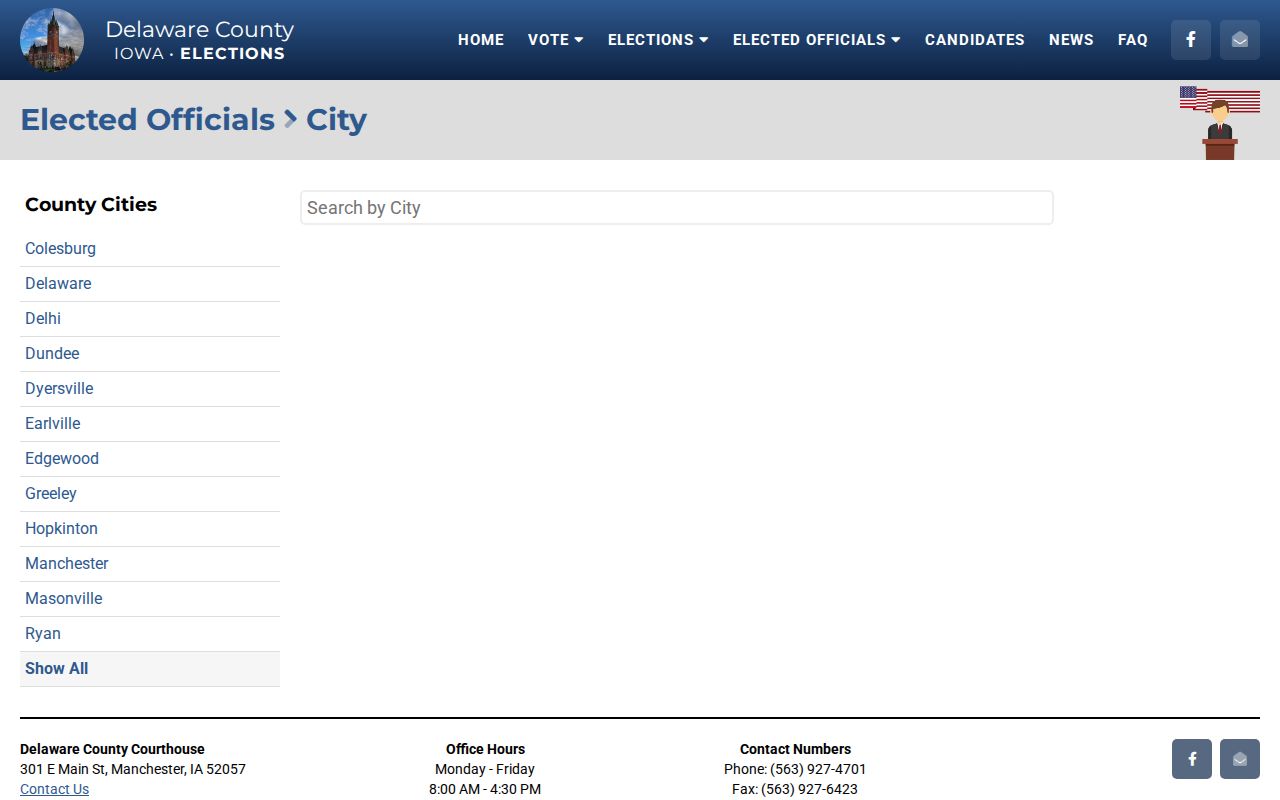
The directory is useful for an ordinance or city-record question, while the Delaware County court remains the source for a judicial warrant.
Municipal Warrants: What They Show
An Iowa arrest or failure-to-appear warrant form carries court authority, not a city portal's branding. Public case data may omit restricted service returns, bonds, or confidential details. Verify the live status directly, especially after payment or a court appearance.
| Case number | The Iowa criminal case key, such as AGCR012345; confirm the real format. |
|---|---|
| Offense or statute | The alleged matter tied to the complaint, citation, or failure to appear. |
| Issuing court | Iowa District Court for the county where the case was filed. |
| Bond or fine | Any amount is controlled by the order and is not guaranteed by a public schedule. |
| Status | Issued, served, returned, recalled, or quashed may be recorded, though not every field is public online. |
Dyersville Warrants Cross County Lines
Dyersville spans Delaware and Dubuque counties. A city police contact alone cannot answer which district-court clerk holds a case. Read the citation and search with the correct county filter. If the result is unclear, ask the issuing agency which county received the filing, then contact that county's clerk.
This geographic check can prevent payment or records requests from going to the wrong office. It also shows why a supposed “Dyersville municipal warrant portal” would be misleading. The warrant follows the judicial case. City population or city boundaries do not establish court volume, warrant status, or jurisdiction by themselves.
Note: A city name identifies local context; the filing county identifies the Iowa court record.
Clearing a Municipal Court Warrant
Delaware County publishes no municipal recall form, automatic payment clearance, or standing amnesty program. Identify the issuing case and ask the clerk or an Iowa attorney which hearing, motion, appearance, payment, or bond action is required. Do not assume the city police department can cancel a judicial order.
- Confirm the county, case number, warrant status, and required next event.
- Follow the court-approved appearance, motion, payment, or bond process.
- Attend each setting and retain proof of payment or filing.
- Obtain court confirmation that the warrant was recalled or otherwise resolved.
Warning: A payment receipt does not itself recall a warrant. Confirm the judge's order or current status with the clerk.
Delaware County Public Access Limits
Iowa Judicial Branch guidance directs district-court case requests to the county clerk. A request should name a case, citation, party, record type, or narrow date span because staff do not perform open-ended research. Copying, postage, review, redaction, supervision, and staff time may result in a charge. No specific Delaware County warrant-copy fee was found.
Iowa Open Records Law permits access subject to exceptions. Juvenile, sealed, confidential, and ongoing investigative material may not appear in an ordinary public search. The Iowa On-line Warrants and Articles System is limited to criminal-justice agencies. It is not a public statewide lookup.
The sheriff's custody roster also answers a different question. A person can be in custody without appearing on a city warrant list, and absence from custody cannot prove that a warrant is gone. Court status must come from the court or responsible agency.